Elephant Hill is the Jeep trail in the Needles District of Canyonlands National Park that everyone tells you to run, and it earns its reputation. I rate it a 6 out of 10, with a steep, rocky gatekeeper climb right out of the parking lot, switchbacks you have to reverse through, and a really narrow section on the loop. I ran it in my lifted JKU with a spotter, and it is one of my favorite trails.
This guide is everything I wish I had in one place before I went: the permit and how to book it, how hard Elephant Hill really is, how long it takes, where to get gas, what vehicle you need, and a look at the trail in the order you meet it.
Elephant Hill at a Glance
| Location | Needles District, Canyonlands National Park, Utah |
| Distance from Moab | About 75 miles to the Needles Visitor Center, roughly 1.5 hours each way |
| Difficulty | Red Rock 4-Wheelers: 5. onX Offroad: 6. My rating: 6 out of 10 |
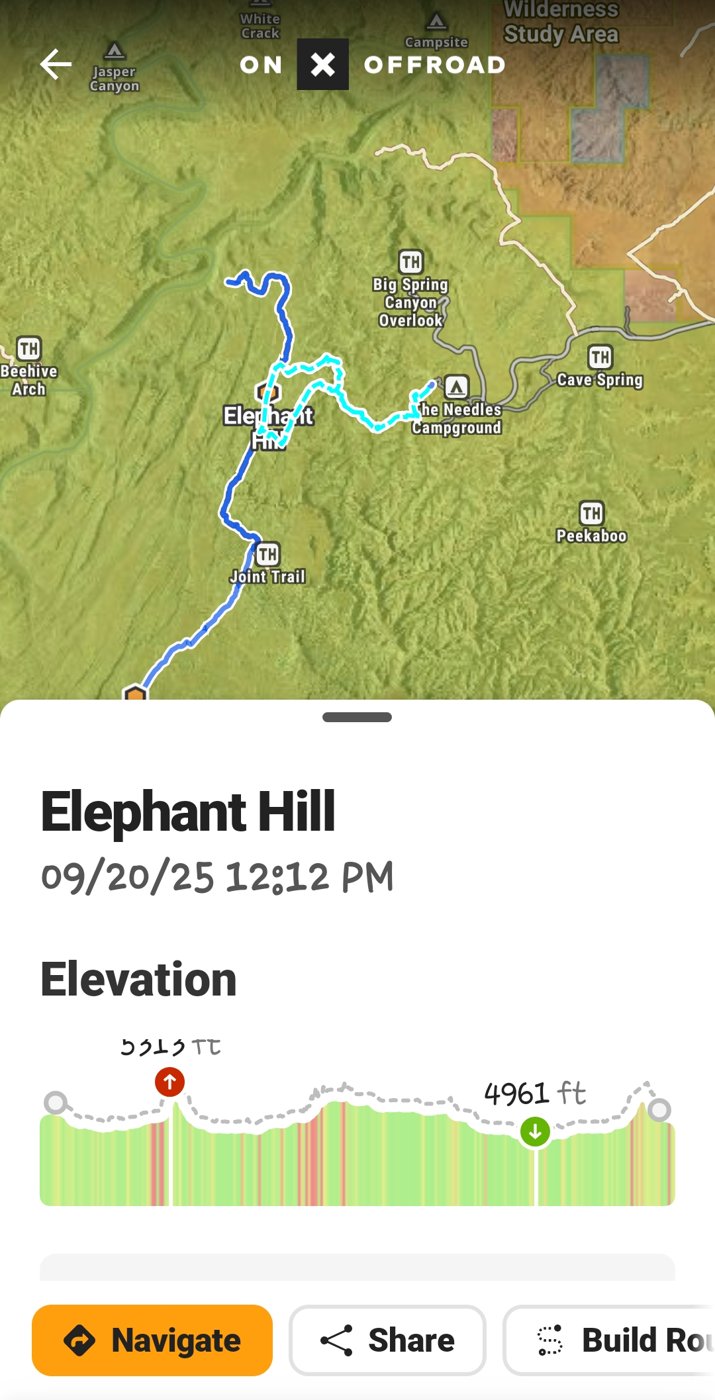
| Highest point | About 5,315 feet |
| Length | About 9 miles for the basic run, up the hill and around the loop |
| Time on the trail | About 3 hours for the basic run, plus time for spotting and photos |
| Permit | Day-use permit required, 24 vehicles per day |
| Booking | Recreation.gov ($6 fee, opens 8 a.m. Mountain the day before) or in person at the visitor center |
| Group rules | Up to 3 vehicles per group, 30 minutes between groups |
| Vehicle | High-clearance, low-range 4WD, 21 feet long and 85 inches wide or less, no pets |
| Traffic | I saw only 2 other rigs on the trail |
| Last fuel | Needles Outpost, about $10 a gallon when I went |
| Jeep Badge of Honor | Yes |
Why I Ran Elephant Hill (and the Trail Mater Business Card)
The owners of the Airbnb I stayed at in Moab told me I had to run Elephant Hill. I had never been on it, so I did what I always do: I watched videos. A lot of them. The more I watched, the less sure I was about running it without a group.
Before heading out, I stopped at Moab Motorsports, home of the Trail Mater YouTube channel. If you watch off-road recovery videos, you have seen those rescue rigs. Sean from the channel was in the office and gift shop that day. I showed him my Jeep and asked if he thought I would do okay on Elephant Hill.
His answer: “Yeah, you’ll be fine. Here’s our card.”
Hahaha. That business card has lived in my Jeep ever since, and I am happy to say I never had to use it. So off to Elephant Hill I went.
How Hard Is Elephant Hill?
I call Elephant Hill a solid 6 out of 10. It is a real rock-crawling trail, but it is not the hardest trail around, and the ratings back that up: Red Rock 4-Wheelers lists it as a 5 and onX Offroad rates it a 6. Moab has harder trails, but Elephant Hill gets your attention for other reasons.
The National Park Service calls it one of the most technical four-wheel-drive roads in Utah, with steep grades, loose rock, stair-step drops, tight turns and backing. It also warns that towing from this road usually costs more than $1,500, and that inexperienced drivers should not attempt it.
What makes it hard is not one big obstacle. It is the combination:
- A steep, rocky climb right at the start that makes you question whether you belong there
- Tight switchbacks that make you back down and up short sections
- Ledges with real exposure
- A really narrow section on the loop that scrapes up wider rigs
- A remote setting where help is a long way off
The good news is that there are breaks. The loop has flat, easy sandy stretches between the tough spots, and they are a welcome reprieve.
Elephant Hill Trail Guide: What You’ll Drive, in Order
Here is the trail in the order you meet it. The first part is two-way, which means you share it with oncoming rigs, and some of the tricky spots are on it. The one-way loop does not begin until you have finished the reverse switchback below.
The Drive In and the Trailhead Parking Area
The drive to the trailhead is part of the fun. It is a simple dirt road, but it is beautiful, and there is nothing like being on dirt roads in Utah. Just stay alert. On a later trip out there, a driver coming the other way flew around a blind turn and almost took me out. Slow down, use your head, and don’t do anything that can turn a good day into a bad one, especially for someone else.
Elephant Hill starts at the trailhead parking area, the same lot hikers use, at the end of a 2WD access road that runs about 3 miles each way. At the start of the 4WD road there is a big sign with the requirements: a day-use permit is required, a backcountry permit is required for camping, and all types of OHVs, including street-legal ones, are prohibited. There is a no-pets symbol on it too. Read it before you head up. The National Park Service says the lot has picnic tables and vault toilets and can fill early in spring and fall.
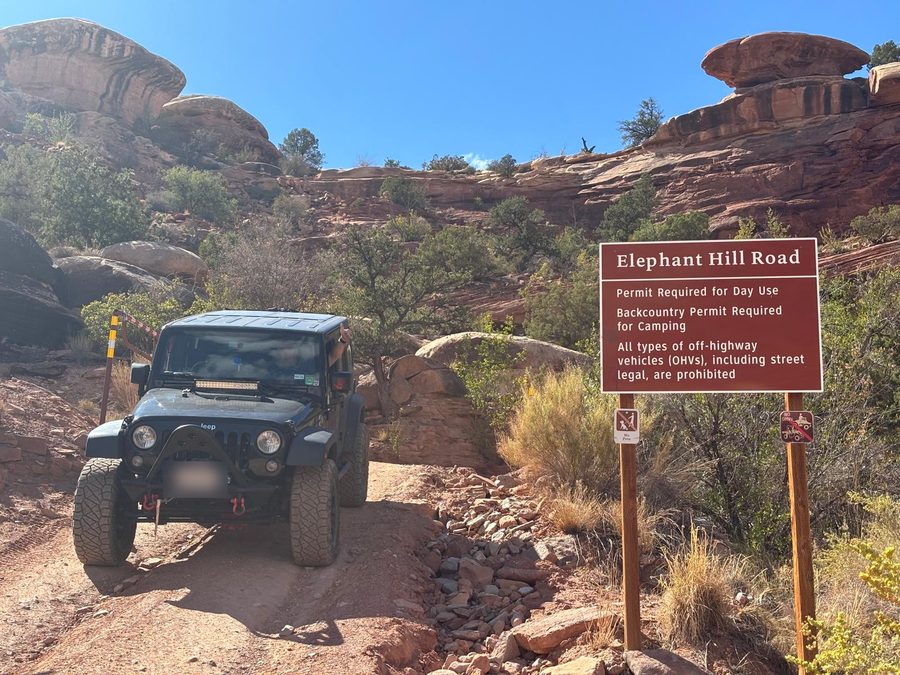
Air down here, in the parking lot, before you start the trail. I dropped to about 15 PSI. Do it before you leave the lot, not once you are on the climb.
The Gatekeeper Climb
The trail starts climbing immediately from the parking lot: steep, rocky, stair-stepped ledges, with a couple of switchbacks right away. Some of the ledges have had concrete poured on them to help vehicles up.
This is the gatekeeper, but not because of one huge obstacle. It is not an 8-rated trail. It is a psychological gatekeeper that makes you question whether you are doing the right thing. The sign says a permit is required, yet people stumble onto this road and try it anyway, and this climb is where they find out they should not have. On a later visit to the trailhead, a ranger asked to see my permit as soon as I pulled into the lot. If this climb makes you question it, listen to that.
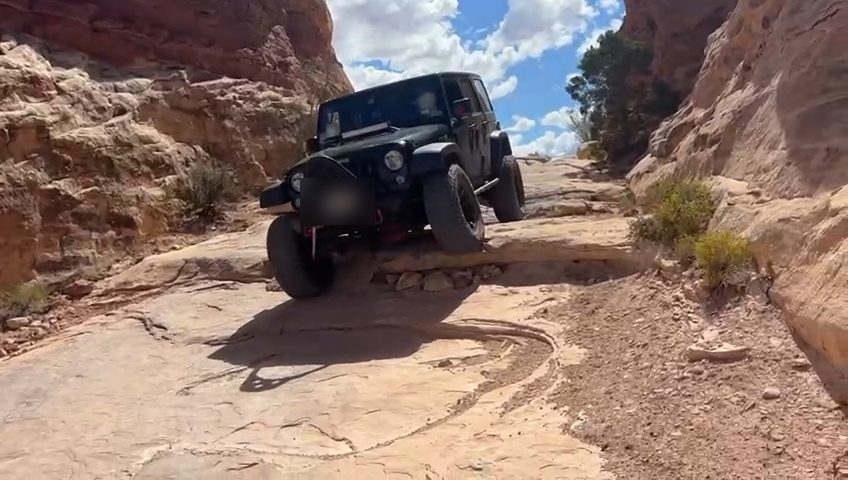
I used a spotter very early on this climb. I am really freaked out by ledges, so I wanted another set of eyes. I probably did not need the help there, but it was a good call.
The Turnaround Halfway Up the Climb
About halfway up, there is a spot where you actually turn around, and then you continue up the climb. It is a weird little maneuver, so take it slow and let your spotter guide you.
Where It Levels Out: The Good Obstacles
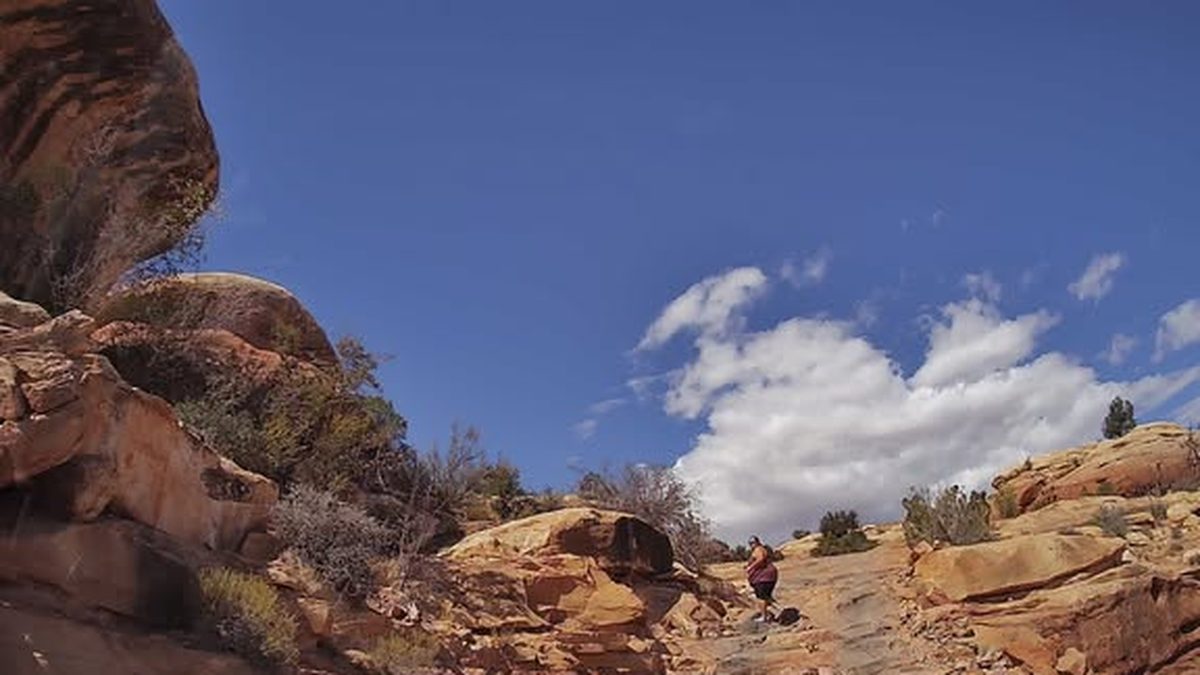
After the climb, the trail levels out a little and you hit some good obstacles. This is still the two-way part of the trail, and some of the tricky spots are here, so keep an eye out for oncoming rigs. I only saw 2 other rigs on the trail, but in a tight spot one is enough to cause a problem.
The Reverse Switchback (Still on the Two-Way Section)
Then the trail starts to descend, and this is where you hit the switchback you have to nose into and back down. It is still on the two-way part, so watch for traffic coming the other way. The turn is too tight to make in one pass, and signs on the trail tell you to back up, so that is what I did. I am a rule follower. Take your time, use your spotter and your radios, and make small, controlled moves. Reverse switchbacks are where mistakes cost you a bumper or a tow.
When you reach the bottom, the loop begins. There are more switchbacks right where the two-way section meets the loop.
The One-Way Loop
The loop starts at the bottom of that descent, and from here the route is one-way. Between the tough spots there are flat, easy sandy sections, and they are a nice reprieve after the climb. Use them to catch your breath, check in with your spotter, and get ready for the next obstacle.
The Narrow Section on the Loop
The loop has a really narrow section, and it is the tightest part of the trail: a gap between two big rock walls. I got my JKU through with the mirrors pushed in, and we did fine. It was cool. Here is what to know before you commit to it:
- Fold your mirrors in. I pushed mine in and got through fine.
- Have your spotter get out first. Before any very narrow section, let the spotter get out. If you have trouble while you are in the gap, they may not be able to open their door.
- Pick one line and hold it. In a gap this tight there is no room to correct.
- Know your width. The park caps vehicles at 85 inches wide, and people scrape up paint, flares and racks here and lose mirrors.
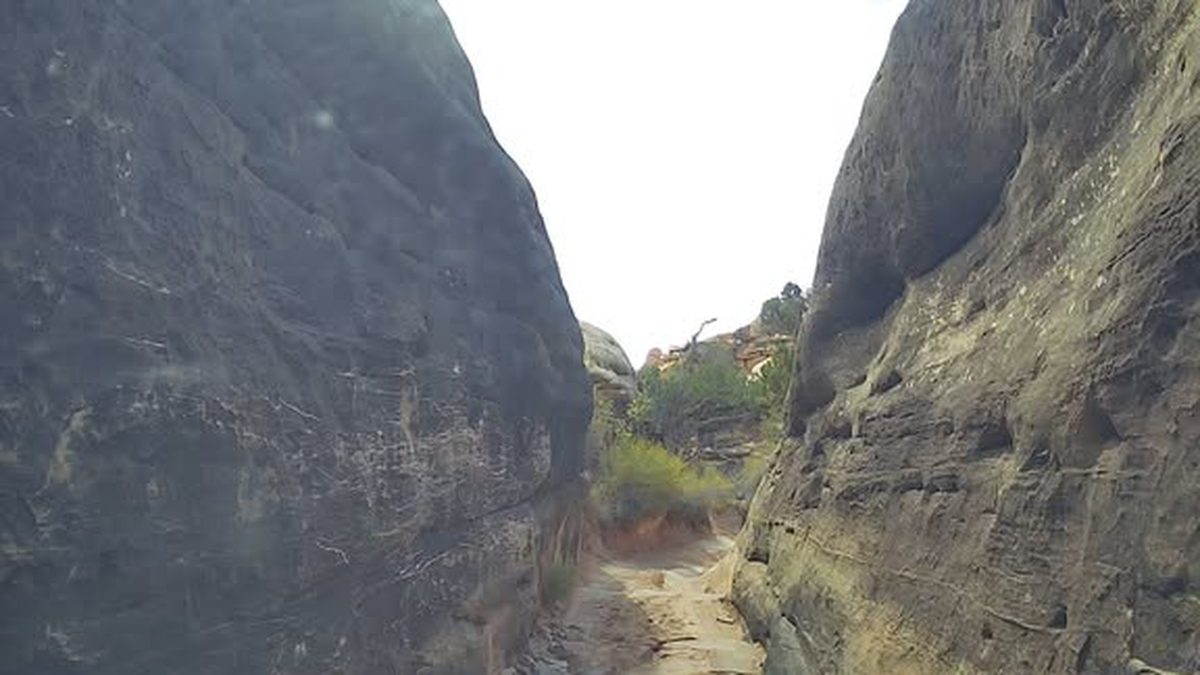
I would not recommend a full-size rig on this section. There is no room for error. If you have any doubt about your rig, walk it first.
Back Up the Switchback and Into the Hole
After the loop, you are back at the nose-in switchback, and this time you back up it. Like the first one, it is too tight to turn around in, and the signs say to back up. Once you can go forward again, you keep climbing back up the hill, and there is a hole that a lot of people get sucked into.
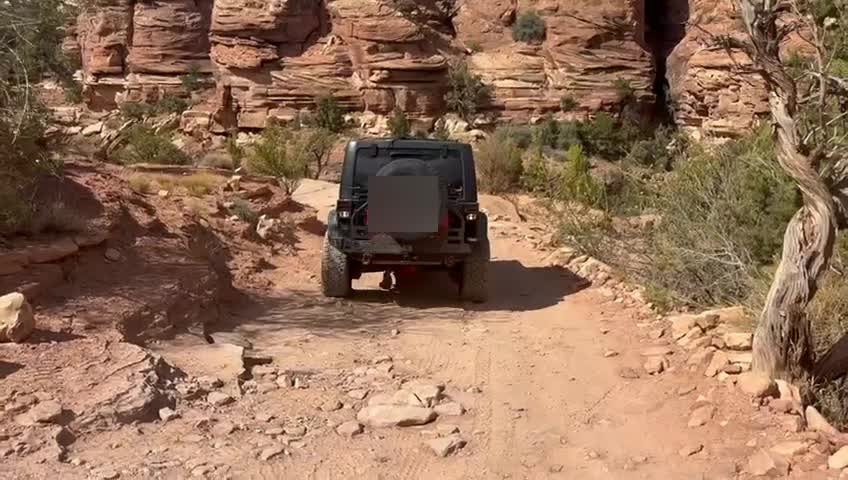
I got sucked into it myself. I was looking for a winch point at the time. I backed out, adjusted my line and used my spotter to get through. No winch required. Pick your line before you commit, and do not let the momentum of the climb carry you into the hole.
From the top it is back down the hill to the parking lot.
The Scenery Is Half the Reason
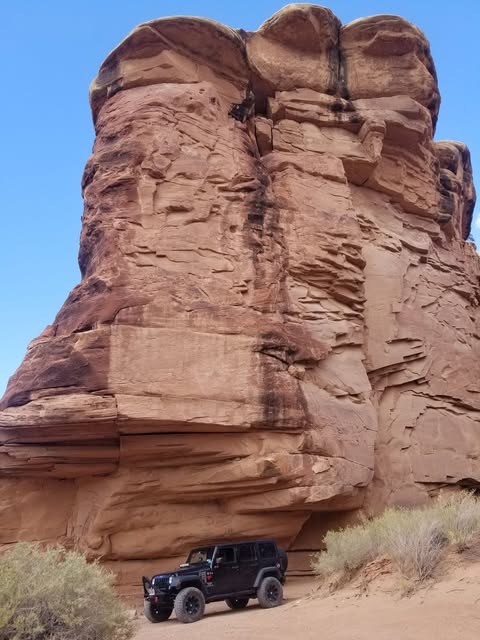
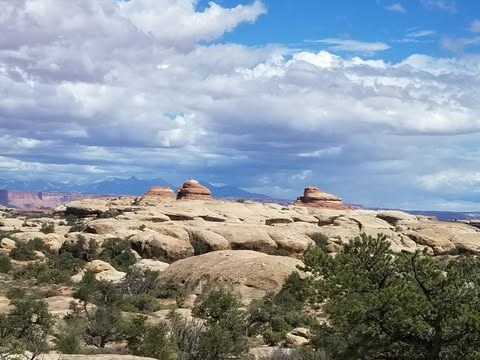
I am not here just to drive over big things. I drive trails like Elephant Hill to see the sights, and my Jeep is what gets me to them. The Needles District is full of towering sandstone fins and slickrock views that stretch to the horizon.
How Long Is Elephant Hill, and How Long Does It Take?
Mileage and time depend on what you count, and the National Park Service does not publish a mileage or a drive time for the road. These numbers come from trail guides and mapping sites.
- Up and over Elephant Hill (two-way traffic). Every group climbs the hill from the trailhead and comes back out the same way. The access road to the parking lot is about 3 miles each way.
- The one-way loop. After the reverse switchback at the bottom of the hill, the route becomes a one-way loop. Trail guides list the basic run, up the hill and around the loop, at about 9 miles and roughly 3 hours.
You will see longer numbers online, around 21 to 22 miles. Those count optional side routes, which I did not run and this guide does not cover. Add time for spotting, backing up, photos and a lunch stop, plus the highway drive of about 75 miles each way from Moab.
Elephant Hill Permit: Cost, Rules and How to Book
Every vehicle on Elephant Hill needs a day-use permit. Here is how it works, per the National Park Service (check the NPS day-use permit page for current details before you go):
- Online: Book on Recreation.gov. Permits open at 8 a.m. Mountain Time the day before your trip, and there is a $6 reservation fee. I booked mine online.
- In person: Unreserved permits are available at the visitor center on the day of your trip, with no reservation fee. They stop issuing an hour before closing.
- Daily limit: 24 vehicles per day. That is why the trail felt uncrowded. I saw only 2 other rigs.
- Group size: Up to three vehicles per group, and each vehicle needs its own permit.
- Spacing: Groups must be separated by 30 minutes of travel time.
- Park entrance fee: Separate from the permit, and charged per vehicle.
The road requires a high-clearance, low-range four-wheel-drive vehicle. Vehicles over 21 feet long, ATVs and UTVs are not allowed, and pets are not permitted, even in the vehicle. Overnight trips need a separate overnight permit.
Getting to Elephant Hill: Moab to the Needles District
Elephant Hill is in the Needles District of Canyonlands National Park. That is not the Islands in the Sky District, which is the part most people see first. Canyonlands is split into districts, and getting from one to another is a real drive. From Moab, the Needles Visitor Center is about 75 miles and roughly an hour and a half each way. My drive home took about an hour and fifteen minutes. If you are planning a bigger Moab trip, my guide to renting a Jeep in Moab covers what to know before you go.
Where to Get Gas Before Elephant Hill
Fuel is the thing to plan for. Fill up in Moab before you leave. Fuel gets scarce out there.
The one last-chance option is Needles Outpost, a privately owned stop right before you enter the Needles District, roughly 30 miles off the main highway. They have gas pumps, a small convenience store and campsites. You do not pump the gas yourself: go inside and they will come out and pump it for you. When I went, gas was about $10 a gallon. The peace of mind was worth it, and a business that remote deserves your support. I stopped again on the way out for stickers and some victory ice cream.
What Vehicle Do You Need for Elephant Hill?
The park requires a high-clearance, low-range four-wheel-drive vehicle that is 21 feet long and 85 inches wide or less. Red Rock 4-Wheelers says the trail is known for challenging stock vehicles, so you want clearance, underbody protection and good tires. Here is what I ran it with, and it handled the trail just fine.
I ran it in Black Betty, my 2017 Jeep Wrangler Unlimited (JKU) Sport:
- 4-inch lift with Clayton springs
- Bilstein shocks
- Long arm kit
- 35-inch Nitto tires, aired down to about 15 PSI off-road
- No beadlocks and no lockers
- Lots of armor underneath
I also carry GMRS radios, a satellite messenger and recovery gear. Black Betty did great on the rocks, and she was just as comfortable on the highway drive back to Moab.
The takeaway: whatever you drive, you do not need a rock-buggy build, but you do want clearance, underbody protection, a good set of tires, and a rig that is narrow enough for the tight section on the loop. I have owned both a Wrangler and a Tacoma, and I wrote up what I have learned owning both.
Best Time to Run Elephant Hill
Spring (March through May) and fall (September through November) are the best seasons. Summer highs can top 100 degrees, and winter weather or rain can make slickrock treacherous and washes impassable from flash flooding. The National Park Service says poor driving conditions and flooding may make the roads impassable, so check the Canyonlands road conditions page before you go.
Should You Run Elephant Hill Alone? Spotters and Safety
I used a spotter twice: once early on the climb, and again on the way out where the hole is. Both times it was worth having another set of eyes.
Here is what I would tell anyone:
- Do not run it alone. If you take one thing from this article, take this. Watch some Trail Mater videos and you will see how many rigs have mechanical failures on this trail. Of course, you should never run any trail alone.
- Use a spotter, and have them get out before narrow sections. If you get stuck inside a tight spot like the narrow section on the loop, they may not be able to open their door.
- Bring radios. GMRS radios let you and your spotter talk while you are out of sight of each other.
- Plan for limited cell service. Cell service is very limited out there, so have a backup. I use a SPOT X satellite messenger, and I now carry my Starlink dish too.
- Help is a long way off. I saw only 2 other rigs on the trail. I talked with Jeff, the owner of Jeff’s Grand Tire, who does some of the recoveries for Rory Irish and Trail Mater. He told me that when you call for help in an area like this, you are waiting until the next day for someone to arrive because of the travel time. Pack like you might be out there a while.
- Carry recovery gear, and know how to use it.
Decide before you leave Moab how you will call for help.
What to Bring to Elephant Hill
- Your day-use permit, printed or saved on your phone
- A full tank of gas from Moab
- A spotter, GMRS radios and a satellite messenger
- Recovery gear, plus a tire gauge and air compressor to air down in the parking lot and air back up afterward
- Plenty of water
- A detailed map, such as the National Geographic Trails Illustrated map of Canyonlands
- A vehicle 21 feet long and 85 inches wide or less, with no pets in it
Is Elephant Hill a Jeep Badge of Honor Trail?
Yes. If you collect Jeep Badge of Honor trails, Elephant Hill is one of them. That is part of what makes it a bucket-list run for Jeep owners, and it is a good reason to plan the permit well ahead of time. I was skeptical going in, and I came away calling it one of my favorite trails I have ever done. Looking for another Moab trail to add to the list? Here is why Fins ‘N Things belongs on every Jeeper’s Moab bucket list.
Elephant Hill FAQ
Is Elephant Hill hard? Yes, but it is not the hardest trail around. Red Rock 4-Wheelers rates it a 5 and onX rates it a 6. The National Park Service calls it one of the most technical four-wheel-drive roads in Utah. I rate it a 6 out of 10.
Do you need a permit for Elephant Hill? Yes. Every vehicle needs a day-use permit, and only 24 vehicles are allowed per day. Book on Recreation.gov, or get one in person at the visitor center on the day of your trip.
How long does Elephant Hill take? The basic run up the hill and around the one-way loop is about 9 miles and roughly 3 hours by trail guide estimates. Longer numbers you see online count optional side routes.
How far is Elephant Hill from Moab? The Needles Visitor Center is about 75 miles from Moab, roughly an hour and a half each way, and the trailhead is a bit further in.
Where is the last gas before Elephant Hill? Fill up in Moab. Needles Outpost, just before the Needles District entrance, has gas, but it was about $10 a gallon when I went.
Can you run Elephant Hill alone? It is not recommended. Bring a spotter, carry a satellite messenger, and expect very limited cell service. Help is a long way off, and a recovery call can mean waiting until the next day.
Can a stock vehicle do Elephant Hill? Red Rock 4-Wheelers says the trail is known for challenging stock vehicles, and the park requires high clearance and low-range four-wheel drive. I ran it in a lifted JKU with 35-inch tires and underbody armor, without lockers.
Can a full-size rig get through the narrow section? I would not recommend it. I got my JKU through with the mirrors pushed in and we did fine, but it is very tight and there is no room for error. If you have any doubt about your rig, walk it first.
Is Elephant Hill a Jeep Badge of Honor trail? Yes.
Plan Your Elephant Hill Trip
If you go, go prepared: fill your tank in Moab, book your permit, bring a spotter, carry recovery gear, and take a satellite messenger or another way to call for help.
And fuel yourself properly before you hit the trail. I run my own coffee at My 4×4 Experience, so grab a bag from my coffee store before your next Moab trip.
Sources
- NPS: Elephant Hill Road day-use permits
- NPS: Four-Wheel-Drive Roads in The Needles
- NPS: Needles trails and roads guide (PDF)
- Red Rock 4-Wheelers: Elephant Hill
- onX Offroad: Elephant Hill
Heading out on your own trip? Grab a bag of my coffee and fuel up before you hit the trail.