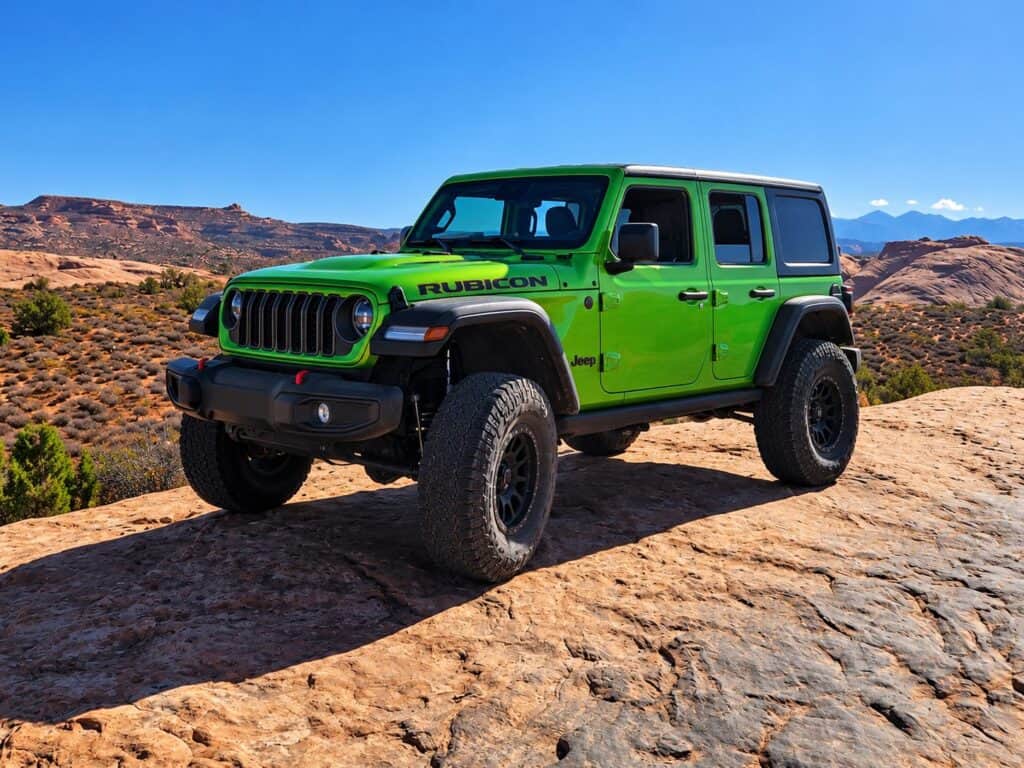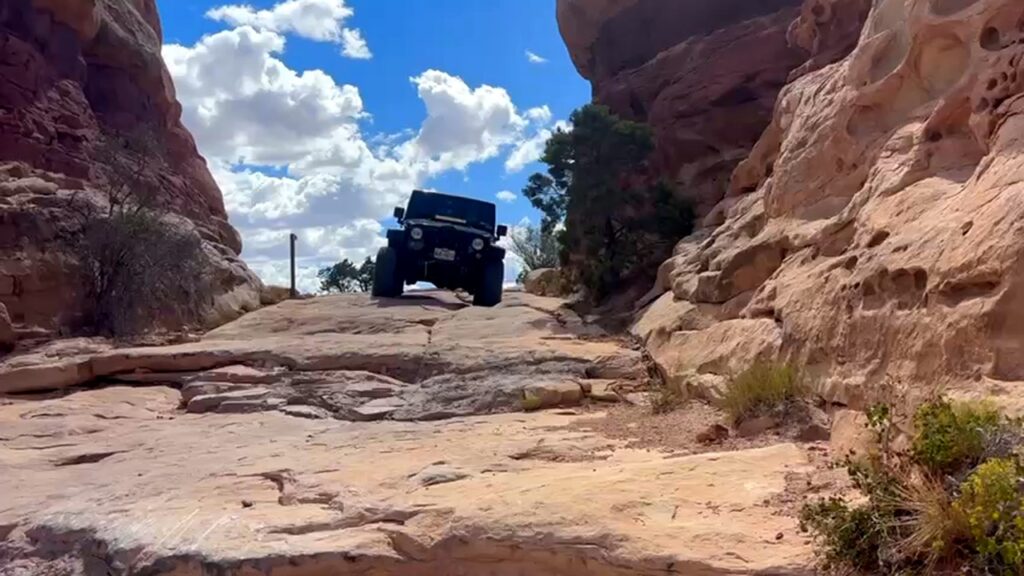
There are trails you do once just to say you did them. And then there are trails that get under your skin — ones you find yourself texting your buddies about months in advance, counting down to, and smiling about on the drive home. For me and my crew, Fins ‘N Things is that trail.
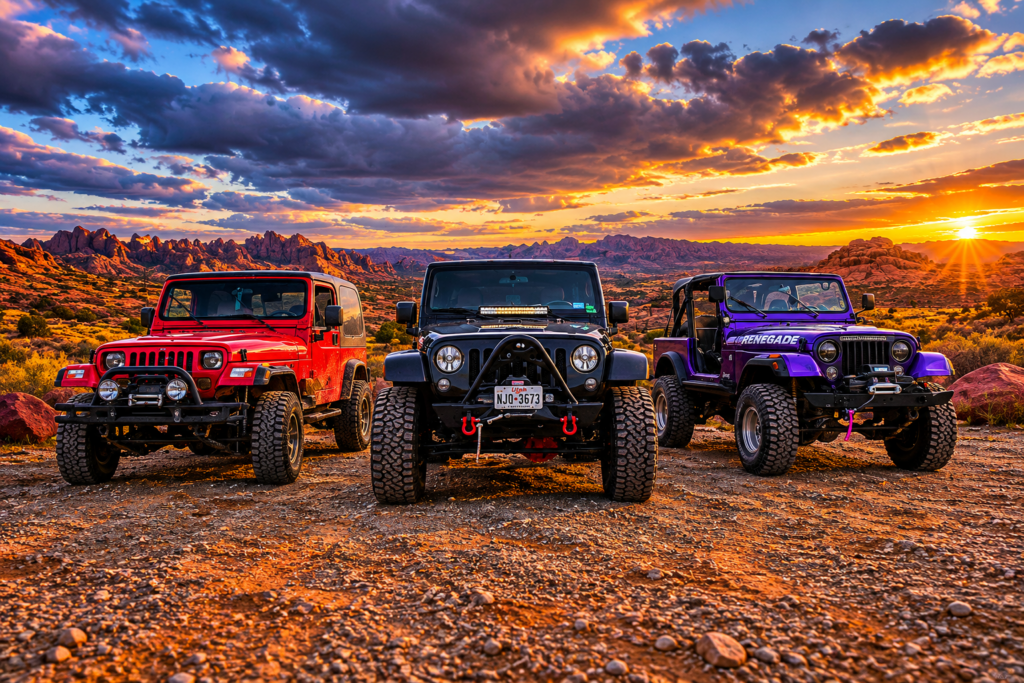
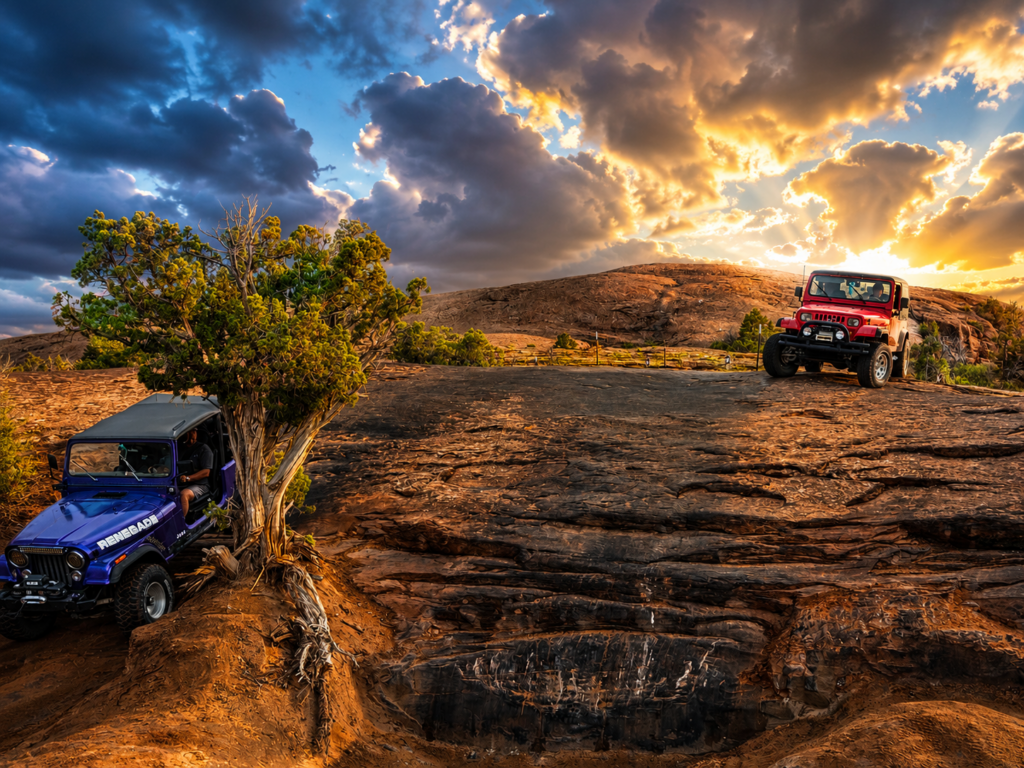
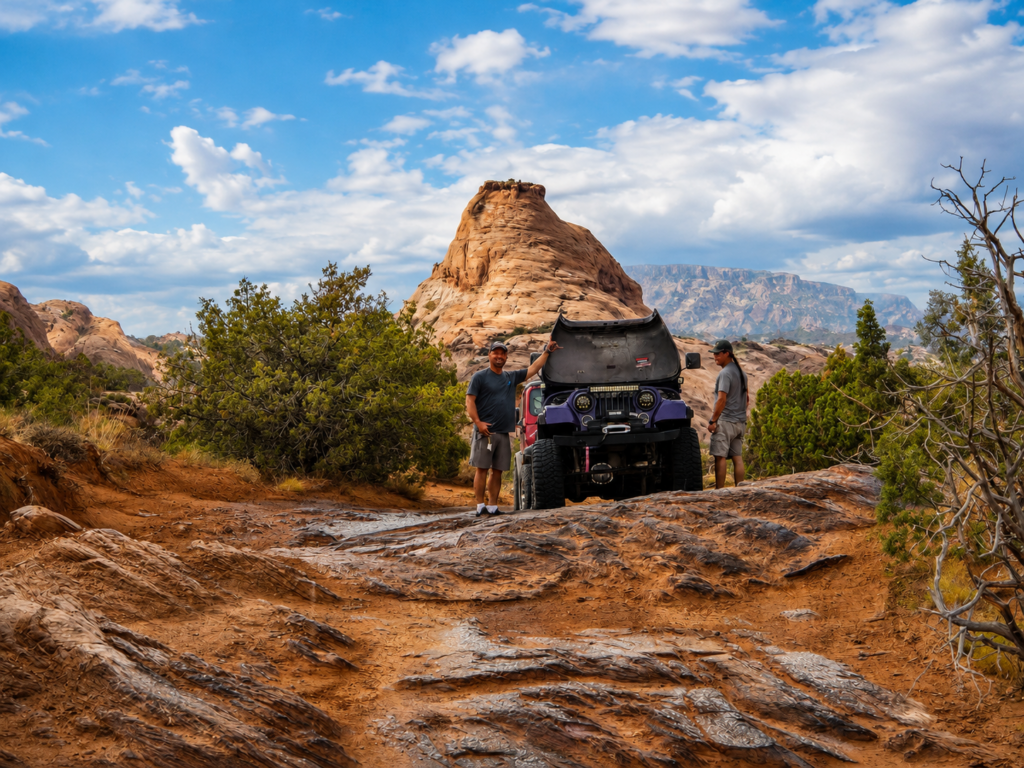
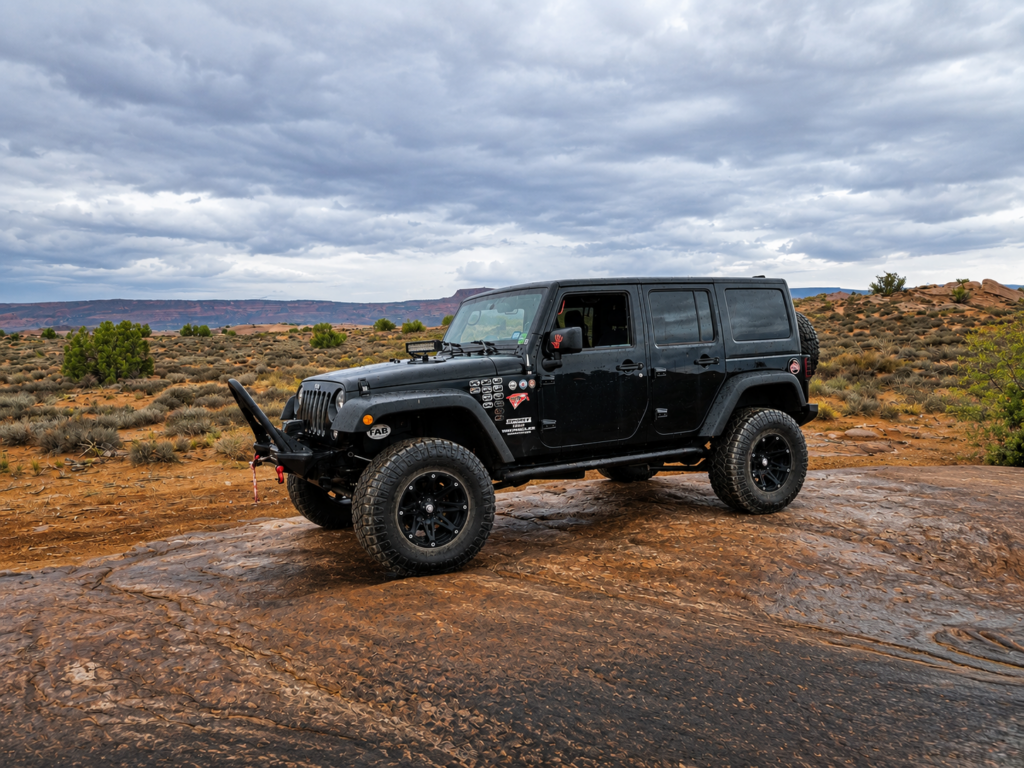
Last September — September 2025 — marked our third time running it together — me and my friends from New Mexico, staged up in the Sand Flats parking area with three very different Jeeps: my black JK Unlimited, a red YJ running a Cummins diesel swap, and a killer purple CJ Renegade. We were all on GMRS radios — something we’ve found makes a huge difference on the trail, both for safety and for just having more fun when you can actually talk to each other rig-to-rig. The sky was doing what Moab skies do — dramatic and unpredictable, with big storm cells building over the La Sal Mountains and the slickrock still wet from an earlier shower. Honestly, it made for some of the best photos we’ve ever taken.
Here’s why we keep coming back — and why you should go.
1. It’s the Quintessential Moab Experience
Fins ‘N Things doesn’t just visit Moab’s famous terrain — it is that terrain. Sandy two-track, loose rock ledges, and miles of smooth, grippy slickrock all in one run. If someone asked you to design the perfect introduction to what makes Moab special, you’d design this trail.
Moab’s reputation is built on slickrock, and Fins ‘N Things delivers it in full. You’re driving on Navajo Sandstone that was deposited as wind-blown sand dunes roughly 200 million years ago, slowly cemented into rock, and is now — very gradually — returning to sand. The trail winds through the results: massive stone fins, rolling domes, deep washes, and open expanses of rock that stretch to the horizon. It’s the kind of terrain that doesn’t exist anywhere else on earth, and this trail puts you right in the middle of it.
And it’s not all slow and technical. Mixed in between the slickrock are curvy, banked sand sections where the trail carves through the desert like a natural racetrack. You can actually build up some speed and let the high banks work in your favor — it’s a welcome change of pace that keeps the whole run feeling dynamic and fun rather than just one long pucker session.
Beyond the geology, Fins ‘N Things checks every box that defines a classic Moab day: a staging area full of rigs from across the country, the hiss of tires airing down, the smell of dust and sage, and the unique camaraderie of strangers spotting each other through obstacles they just met at. If you’ve never wheeled Moab before, this is the trail to start with. If you have, it’s the one you keep coming back to as a benchmark — the trail that reminds you what brought you here in the first place.
2. The Name Tells the Story
The “Fins” are dramatic, blade-like formations of Navajo Sandstone rising from the desert floor northeast of town. The “Things” are what’s left behind as those fins slowly erode over thousands of years. You’re not just driving through scenery — you’re driving through geology in motion.
Speaking of things that take a very long time to form: keep an eye out for cryptobiotic soil crust — the dark, lumpy, almost sponge-like crust you’ll see on the ground between the rocks and sandy areas. It’s a living community of cyanobacteria, algae, fungi, and lichens that stabilizes the soil and plays a critical role in this desert ecosystem. It can take 50 to 250 years to develop, and a single footstep can destroy it. Stay on the trail, keep your tires on designated surfaces, and if you have to get out of your rig, step on rock or bare sand. The “don’t bust the crust” rule is taken seriously in Moab for good reason.
3. It’s Challenging Without Being Punishing
Fins ‘N Things is rated a 4 out of 10 by Red Rock 4-Wheelers — the local Moab club that knows these trails better than anyone — and that’s a fair call. It’s not Hell’s Revenge. It’s not going to eat your Jeep alive. But it demands your full attention, rewards good technique, and will absolutely humble an overconfident driver. That sweet spot is hard to find and harder to recreate. Clubs and shops like that are exactly the people worth supporting in the off-road community.
Our group, Pickle Offroad, has a running joke that one of the trail’s most memorable “obstacles” isn’t a steep slickrock climb at all — it’s a cattle guard with a sharp drop-off right after your rear wheels clear it. Catch it wrong and the concrete will tag your rear bumper with a jolt that’ll wake up everyone in the cab and probably the rig behind you too. It’s not dangerous, but it is a good reminder that on Fins ‘N Things, the surprises aren’t always where you expect them.
4. No Lockers Required
This trail does not require lockers, which makes it one of the best options for a mixed group. A lifted 4×4 with quality all-terrain tires is going to have a great time. Even a capable stock SUV with a skilled, patient driver can handle most of it. Bring your friends without worrying about leaving them behind.
We’ve seen this firsthand. On one of our runs, someone in our group completed Fins ‘N Things in a completely stock XJ. Was there some creative spotting involved? Absolutely. But they made it through clean. Meanwhile, I was running my JKU Sport on 35s with a limited slip and 3.73 gears — no lockers — and had zero issues. Fins ‘N Things is truly a “run what you brung” trail. Good tires, good spotting, and patience will get you a lot further than a fully built rig with a heavy foot.
5. You Can Run One Half or Both — Know the Difference
Plan on 3 to 4 hours and don’t rush the early miles. The first half works through sandy washes and rocky two-track with the La Sal Mountains filling your mirrors — a mellow, scenic warmup that gets newer drivers dialed in before the trail gets serious. It’s good trail design, whether intentional or not.
That said, don’t sleep on the first half entirely. There’s at least one steep descent in there that absolutely deserves your attention. The line is narrow: drift too far one direction and your tire drops into a hole that can flip you; drift too far the other and you’re going off the edge. It’s not long, but it’s unforgiving. This is exactly the kind of spot where having a spotter outside the rig pays off — someone who can see both hazards at once and walk you through the correct line. If you’re running with a group, use them. If you’re solo, get out and walk it before you commit.
One practical note: pay close attention to the map you receive at the Sand Flats entrance booth. Fins ‘N Things is actually split into two sections divided by Sand Flats Road, and you can run either half independently if time or logistics require it. Here’s how to think about each option:
First half only — The more mellow section: sandy washes, banked curves, two-track, and the campground area with an optional rocky hill climb. Good choice for newer drivers or anyone wanting a lower-stakes afternoon. The downside is you’ll miss the namesake fins entirely — no Kenny’s Climb, no Frenchie’s Fin, no big slickrock. You’ll have fun, but you’ll drive home knowing you left the best part on the table.
Second half only — This is where the trail earns its reputation. The fins, the views, Kenny’s Climb, Frenchie’s Fin — all of it is in the second section. If you’re experienced and short on time, jump straight to the good stuff. The tradeoff is there’s no warmup; you’re going right into the more technical terrain, which can be a cold start for less experienced drivers.
Both halves — The right answer when you have the time. The first half sets you up physically and mentally for the second, and the full loop is the complete Fins ‘N Things experience. Also worth knowing: there’s a pit toilet stop on the trail, so you’re not without options on a 3-4 hour run — something worth noting before you leave the staging area.
6. Kenny’s Climb Will Test You
About 9 miles in, Kenny’s Climb is an optional obstacle and one of the steepest slickrock ascents in all of Moab. It doesn’t have a separate standalone rating — it lives within the trail’s overall 4/10 — but don’t let that fool you. It’s the hardest thing on Fins ‘N Things.
So is it technical or psychological? Honestly, more psychological. The surface is clean, solid slickrock — no ledges, no loose rock, no uneven terrain. Technically, if you’ve driven slickrock before, you have what you need. What gets people is the angle. Standing at the bottom looking up, it appears to be closer to vertical than to driveable. The natural reaction is to hesitate, and hesitation is exactly what will cause you to lose traction and abort. Commit, keep momentum smooth and steady, and the sticky sandstone does the rest. The climb itself typically goes cleanly. It’s the conversation your brain has with itself in the 30 seconds before you point uphill that’s the real obstacle. Skip it if you want — there’s a bypass — but you’ll wish you hadn’t.
7. Frenchie’s Fin Is the Payoff
This is the heart of the trail — a massive slickrock fin with a steep approach and an equally steep descent. When you’re picking your line across the top with nothing but open sky around you, this is the moment the trail earns its name.
To find it: the trail uses white painted markers and small stegosaur paint spots on the rock to keep you on track throughout, so pay attention to those. You’ll pass Stegosaurus Rock around mile 7 — a natural formation that actually looks like its namesake — and then Kenny’s Climb comes up around mile 9. Once you’ve cleared Kenny’s, Frenchie’s Fin is right around the corner at about mile 9.5. Look for a tight left turn that curves you around the edge of the fin and sets up your approach angle for the climb. That turn is your cue. If you miss it and find yourself going straight, back up — you’ve gone off line.
8. The Views Are Outrageous
From the top of the fins you can see the full sweep of the La Sal Mountains to the east and Negro Bill Canyon to the west. Add storm clouds rolling off the mountains — which is exactly what we had last September — and you have the kind of panorama people drive 1,000 miles to see.
9. The Timing Makes a Difference
Spring and fall are the ideal windows — March through May, September through November. Manageable temperatures, golden light, and slickrock that grips better when it’s cool and dry. We’ve run this trail three times: June 2018, June 2021, and September 2025 — and each visit had its own character. The June runs were warm and wide open, the kind of bluebird Moab days that make you never want to leave. The September run gave us something different: storm cells building over the La Sals, wet slickrock, and that dramatic fall light on red sandstone that makes every photo look like a painting. Both work. Any season beats not going.
10. It Creates the Kind of Day You Talk About for Years
Moab has harder trails, longer trails, trails that will genuinely test the limits of your build and your nerve. But Fins ‘N Things hits a sweet spot that’s hard to explain until you’ve done it. Accessible enough to bring newer wheelers. Challenging enough to keep veterans fully engaged. And the scenery — those sweeping views, the stark contrast of orange rock against a storm-dark sky, the quiet that settles over a group of friends parked on top with cold drinks and big smiles — that’s what this is all about.
Third time for us. Won’t be the last.
Getting There: Sand Flats Recreation Area is located approximately 2 miles east of downtown Moab on Sand Flats Road. The Fins ‘N Things trailhead is well-marked. A day pass runs $5 per vehicle; a 7-day pass is $10; an annual pass is $25. Camping is also available throughout the area — Sand Flats has multiple campgrounds right along the trail system, making it easy to base camp and spend multiple days exploring. Reservations for group sites can be made through Recreation.gov. Current conditions and pass information are available through the Grand County official site linked above.
Pro Tips Before You Go
Air down. Drop to 18–22 PSI before you hit the slickrock. The bigger contact patch transforms how your rig handles on the fins — don’t skip this step.
Bring GMRS radios. If you’re running with more than one rig, GMRS radios are a game changer. You can call out obstacles ahead, coordinate spotters, and generally have a lot more fun when you can actually talk to each other without getting out of your Jeep. Highly recommended.
Grab the map at the entrance booth. Don’t assume you know the layout. Fins ‘N Things splits into two sections across Sand Flats Road, and first-timers regularly think the trail is over when it isn’t — or miss the turn back onto the second half entirely. The map clears that up.
Go slow on the steep stuff. Momentum helps on the long slickrock climbs, but bouncing and spinning will kill your traction fast. Smooth throttle inputs, let the tire stick, and trust the sandstone. It has more grip than it looks like it does.
Watch for the cryptobiotic crust. The dark, bumpy soil crust around the trail is a living organism that takes centuries to develop. Don’t bust the crust — stay on the trail and step on rock or bare sand when you get out.
Carry more water than you think you need. There’s no shade on this trail. Even in cooler months, a 3-4 hour run in the desert sun adds up fast.
Pack the basics. Fins ‘N Things isn’t a trail that demands a full recovery kit, but you should always have a fire extinguisher mounted and accessible, a first aid kit, and a tow strap. These aren’t overkill — they’re just smart trail etiquette regardless of where you’re wheeling.
Keep an eye on the weather. Moab storms roll in fast off the La Sals. Wet slickrock is still driveable — we’ve done it — but it changes the equation on the steep sections. Know what’s coming and plan accordingly.
Fuel for the Fins
Slickrock days start early, and a hot cup before airing down makes the first climb a little easier. My 4×4 Experience Coffee is available right here on the site: honest, no-hype coffee for early trailheads and long drives home.
Follow the Adventure
New trail reports, gear notes, and Moab updates go up on the My 4×4 Experience Facebook page first. Come along for the next one.
Go Experience It Yourself
Reading about Fins ‘N Things is one thing. Actually pointing your rig at those fins and feeling the slickrock grab your tires is something else entirely — and that’s the whole point of being here at my4x4experience.com.
Fins ‘N Things has been on our rotation for years, and it earns its place every single time. Whether it’s your first trip to Moab or your tenth, this trail delivers. Stop planning and go do it. The experience is waiting for you.
Related reading: Renting a Jeep in Moab: 9 Things to Know Before You Go and 4 Reasons You WANT a 4 Wheel Drive (4×4) Vehicle to Visit Big Bend National Park.