Thinking about renting a Jeep in Moab? I rented a modified JLU Rubicon on 37s, loaded four passengers into it, and spent the day on Baby Lion’s Back, the second half of Fins ’N Things, and Hell’s Revenge. Here are nine things I learned about cost, capability, trail restrictions, first-time passengers, and whether a Moab Jeep rental is actually worth it.
I already own a capable Jeep.
My JKU Sport is modified with 35-inch tires, a 4-inch lift, and a long-arm suspension, and it has spent plenty of time off-road. So capability was not the reason I rented a Jeep in Moab.
The problem was much simpler:
I had family visiting me in Moab, and my Jeep has no rear seats.
I run a Cargo Dog system in the rear of my JKU, so taking several passengers on the trail in my own Jeep was not an option.
That gave me an excuse to try something I had never done before: take a modified JLU Rubicon off-road.
I rented one from Jenn’s Jeep Rentals in Moab, loaded four passengers into it, and spent the day showing them what Moab off-roading is really like.
By the end of the day, the rental had taught me quite a bit—not just about rental Jeeps, but about passengers, equipment, trail ratings, and once again, why seat time matters so much.
Quick Verdict: Is Renting a Jeep in Moab Worth It?
For me, yes.
My total was $417.39, including the $325 rental price plus taxes and fees.
There were five people total in the Jeep—me plus four passengers—which works out to about $83 per person for a full day of off-roading in Moab.
More importantly, without the rental, my passengers would not have been able to experience those trails with me at all.
Would everyone visiting Moab need to rent one?
Absolutely not.
1. Research Your Trails Before You Rent a Jeep
One of the couples ahead of me at Jenn’s told the staff they planned to take their rental Jeep on Shafer Trail.
They also had a pickup with them that looked perfectly capable of running Shafer.
That made me wonder whether they actually needed the rental.
If you simply want to drive a lifted Jeep in Moab because it sounds fun, I have absolutely no argument with that.
Rent the Jeep. Have fun.
But if you are renting one because you believe your own vehicle cannot handle the trail you want to run, research the trail first.
Jenn’s currently lists Potash Road/Shafer Switchbacks among its easy trails, while Fins ’N Things and Hell’s Revenge are listed as hard trails.
Personally, I would not classify Fins ’N Things or Hell’s Revenge as hard trails overall.
Part of the reason is that both trails give you opportunities to choose easier lines or bypass some of the more difficult optional obstacles.
That matters.
Hell’s Revenge, for example, has easier alternatives around some of its harder features. Some trails do not give you that same luxury.
When I think about a truly hard Moab trail, Pritchett Canyon is a much better example. Many of its major obstacles do not offer a bypass. Cliffhanger is another trail I would put in a significantly more difficult category because of its steep irregular ledges, cliff-side exposure, and more sustained technical driving.
That is more what I mean when I call a trail hard.
That does not mean Fins ’N Things or Hell’s Revenge are harmless. Far from it. There are sections where a bad mistake can have serious consequences, even if the actual driving is not especially technical.
Beginner trails can still have expert consequences.
You also do not need a JLU Rubicon on 37-inch tires to run either trail.
I have had a completely stock Jeep Cherokee XJ in a group on these trails.
A capable vehicle helps.
Seat time helps even more.
Before spending several hundred dollars on a rental, figure out what trail you actually want to run and whether your own vehicle is already capable of doing it.
2. Consider Picking Up Your Rental Jeep the Night Before
The actual rental process at Jenn’s was easy.
I reserved the Jeep online, completed the waiver, and provided my insurance information before arriving.
Because I had already handled all of that online, there was virtually no paperwork when I arrived.
In my case, I also was not asked for a deposit. Your experience may vary.
Jenn’s currently lists its Jeep and Bronco rental period as 8:00 AM to 5:30 PM and offers night-before pickup for an additional $50.
I arrived at Jenn’s at about 8:07 AM.
Two representatives were working, both were already helping renters, and another couple was waiting.
I was starting to get a little impatient, mostly because every minute standing there felt like part of my rental day disappearing.
To be fair, the staff were not wasting time.
They were talking to each renter about the trails they planned to run and giving them useful advice.
By the time I pulled out, it was about 8:40 AM.
That was roughly 33 minutes gone before the day even really started.
The return process later that afternoon?
Maybe five minutes.
Knowing what I know now, I would seriously consider paying for the night-before pickup.
Even if I never drove the Jeep that evening, maximizing daylight and trail time the next morning would be worth it.
3. Tell the Rental Company Exactly Where You Plan to Go
When it was finally my turn, the staff asked which trails I planned to run.
- Baby Lion’s Back
- the second half of Fins ’N Things
- Hell’s Revenge
I suspect the specificity of saying “the second half of Fins ’N Things” gave them some indication that I had some familiarity with the area and knew what I wanted to do.
I am not claiming to be a Moab guru.
But I had a plan.
Fins ’N Things is divided by Sand Flats Road, which makes the second half an easy jumping-in point if you do not want to run the entire trail.
Related article: 10 Reasons Fins ’N Things Belongs on Every Jeeper’s Moab Bucket List
The Jenn’s representative gave me a trail book and went over the routes.
On Fins, he identified two obstacles that were off-limits.
One was a very steep climb where renters sometimes fail to make it up, begin sliding backward, and then get into trouble while the Jeep is still in Drive. His concern was the stress that kind of situation can place on the JLU transfer case.
The second was a steep drop where it is very easy to bury the Jeep’s nose into the dirt at the bottom.
I did not immediately recognize the obstacle from his description.
Once I got there, I knew exactly which one he meant.
I have seen Jeeps become stuck there badly enough to need a winch.
Interestingly, obstacles like Kenny’s Climb were still allowed.
On Hell’s Revenge, Hell’s Gate and the hot tubs were off-limits.
I specifically asked whether Car Wash was permitted.
It was.
The takeaway is simple:
A good rental company should ask where you are going and make sure you understand the restrictions before handing you the keys.
4. Pay Attention During the Walk-Around Inspection
Before I left, the Jenn’s representative walked around the Jeep with me and pointed out existing damage.
That conversation was actually reassuring because it showed me that they understood these vehicles were being rented to go off-road.
They were not overly concerned about normal trail abuse on the stock plastic bumpers.
Same with the stock plastic fenders.
Rock rash on the wheels was not a crisis.
As I remember it, they were also fairly relaxed about normal trail wear on the rock sliders.
Body panels and paint were a different story.
Damage those and, yes, you are going to have a problem.
There was also one very specific instruction:
Do not climb on the hood.
Somewhere in the history of Jeep rentals, somebody clearly made that rule necessary.
The only real question I had before leaving was tire pressure.
They told me the Jeep was already aired down to around 17 PSI.
Perfect.
That meant I did not need to bring tire deflators or an air compressor to air back up afterward.
One less thing to pack. One less thing to think about.
5. A Rubicon on 37s Is Great—But You Probably Do Not Need That Much Jeep
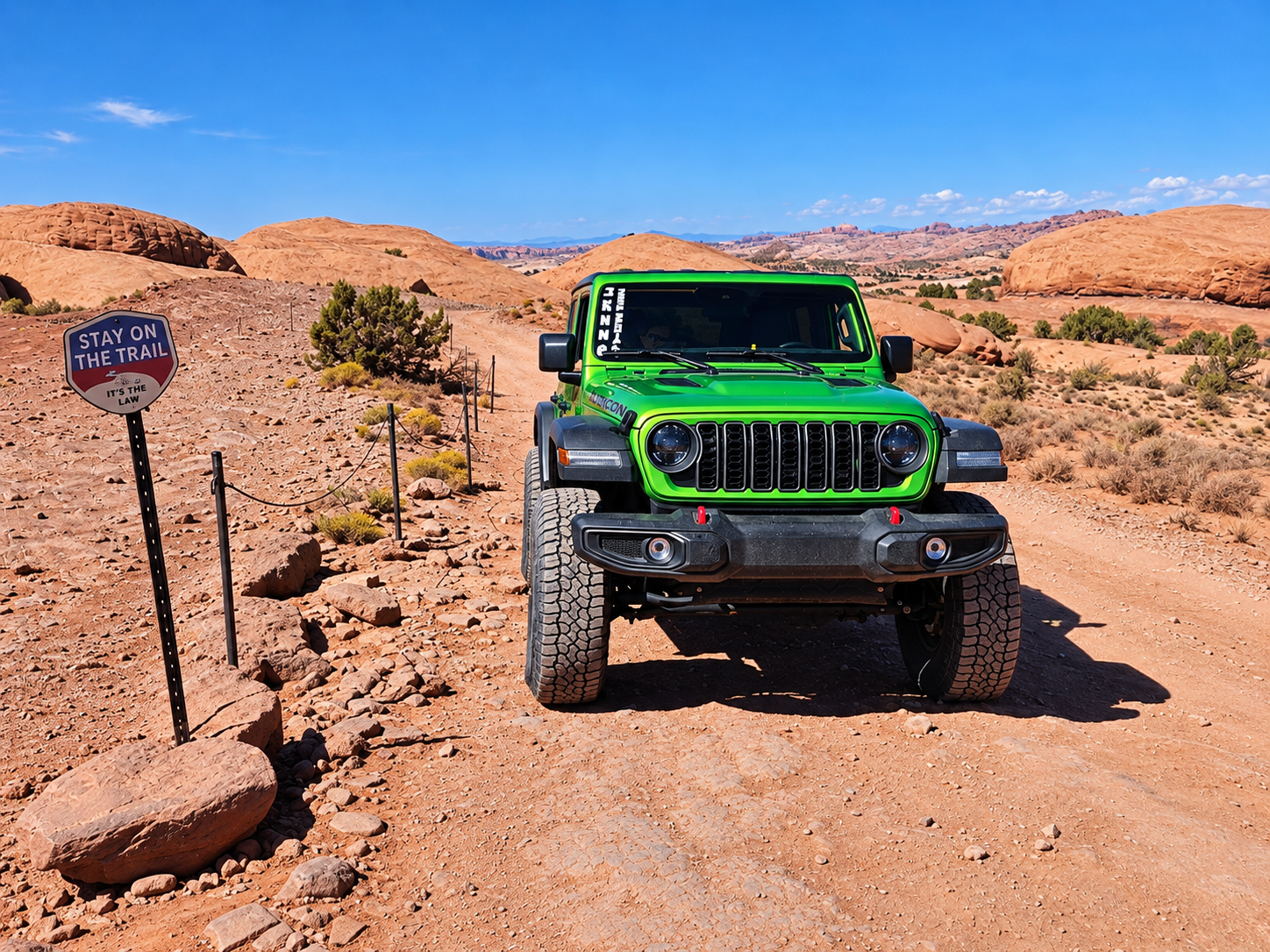
I nicknamed the pistachio-green JLU Rubicon “The Pistachio.”
Jenn’s currently lists its JLU Wrangler Rubicon with a 2.5-inch Clayton or MetalCloak lift and 37-inch Falken tires. The company also highlights the Rubicon’s added capability from Dana 44 axles, 4.10 gears, a 4:1 transfer case, front and rear lockers, larger tires, and increased ground clearance.
My rental fit that general description.
It was on 37-inch Falkens and appeared to have roughly a 2.5-inch lift.
I also remember seeing Rough Country branding underneath, most likely on the shocks, but that does not necessarily mean the entire suspension system was Rough Country.
One of the things that surprised me most was that the 37s did not feel dramatically different from the 35s on my own JKU.
Part of that may simply be the overall setup.
The rental was roughly 37s with a 2.5-inch lift.
My JKU has 35s, a 4-inch lift, and a long-arm suspension.
So I was not comparing The Pistachio to a stock Jeep.
My own Jeep is already set up to flex, clear obstacles, and work off-road.
That may be part of why the rental felt so familiar.
Ground clearance was perfectly adequate for everything I asked it to do.
I used the lockers on a few optional obstacles, mainly steep climbs, but most of the day did not require them.
The Rubicon was enormously capable.
That does not mean all of that capability was necessary.
6. Taking First-Time Passengers Off-Road Changes the Entire Experience
Once I left Jenn’s, I picked up my four passengers.
Before heading to Sand Flats Recreation Area, I made the obligatory stop at Maverik.
After all, it is adventure’s first stop.
I chose the second half of Fins ’N Things and Hell’s Revenge partly because of their proximity to town and partly because I thought they would give first-time passengers a fantastic introduction to Moab.
Before getting serious, though, I decided to ease everybody into things with Baby Lion’s Back.
My passengers looked at the climb.
Then at me.
Then back at the climb.
“We’re going up that?”
Yes.
Yes, we are.
About five seconds into the climb, one passenger was alternating between cussing and praying.
At that point I wondered whether my trail day might be over before it had really started.
The Rubicon, of course, had no problem.
I put it in 4-Low.
No lockers.
I may have disconnected the sway bar. Honestly, I do not specifically remember because in the JLU Rubicon, you push a button.
My JKU is considerably more plebeian.
I have manual quick disconnects.
Baby Lion’s Back is not particularly difficult.
But for somebody who has never experienced anything like it, the combination of the climb, driving along the fin, and then descending the other side is a fantastic introduction to Moab.
There was a short drive afterward before joining the second half of Fins ’N Things.
That gave everyone a chance to recover.
My passengers loved the sandy, off-camber S-turns.
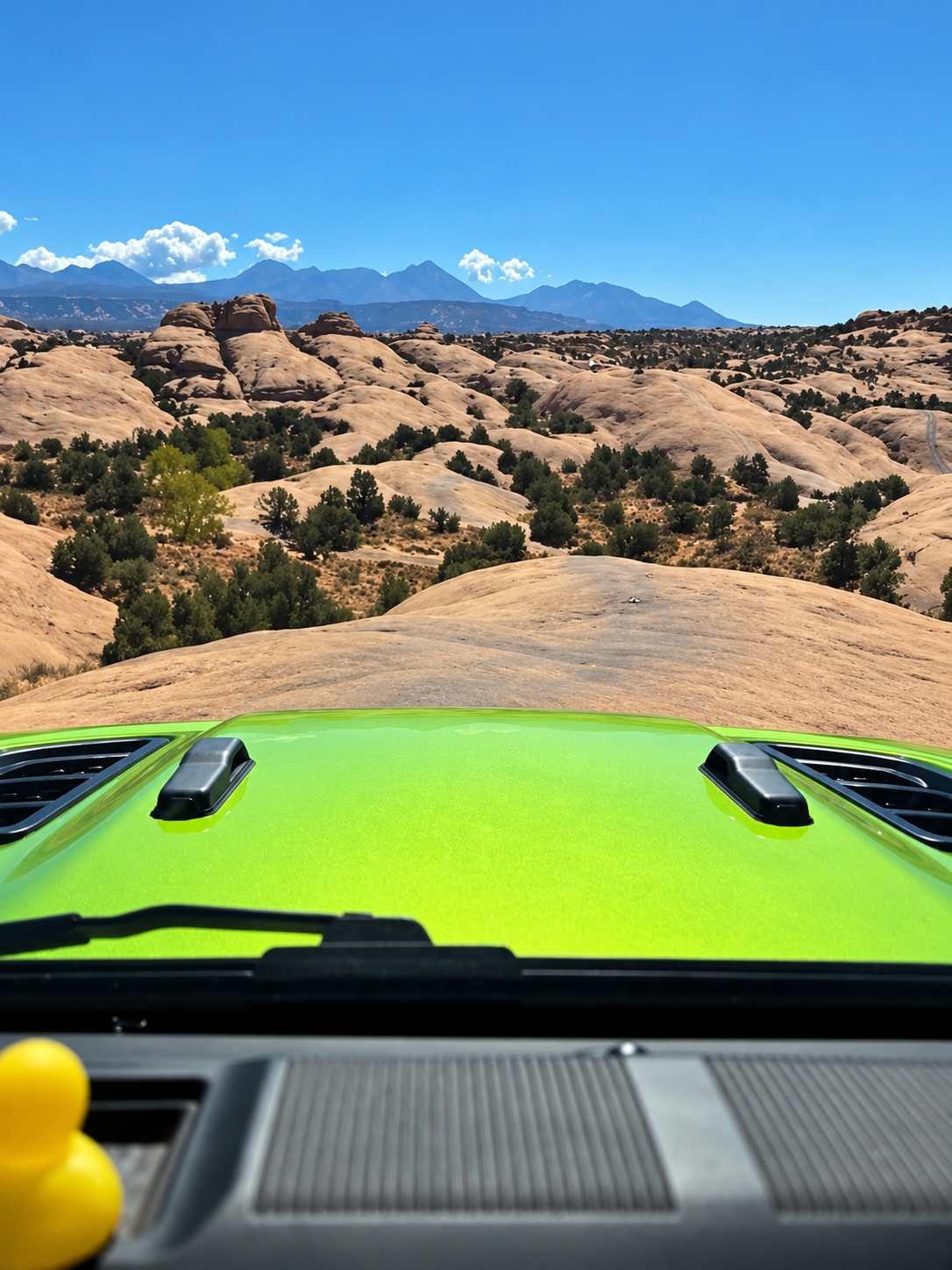
They were considerably quieter during some of the steep slickrock climbs—particularly the ones where the Jeep is climbing, turning off-camber, and you cannot really see where the trail goes until you get farther into the obstacle.
That is where Moab becomes as much psychological as technical.
7. Seat Time Matters More Than Fancy Equipment
By the time I finished Fins ’N Things, everybody seemed ready for more.
I specifically asked whether they still wanted to continue.
They said yes.
Hell’s Revenge said, “Hold my Maverik soda pop.”
The opening fin produced alternating periods of dead silence and gasps from the passenger seats.
If you have never done anything like it, that first fin can be intimidating.
I also made a point of communicating with my passengers throughout the day.
If I knew we were about to get off-camber, slide a little, or hit a section that simply felt more dramatic than it really was, I gave them a heads-up first.
I think that helped.
Maybe not completely, but they were still talking to me afterward, so I am counting that as a win.
For first-time passengers, knowing what is about to happen can make a big difference.
A driver may know that a certain lean angle, descent, or little bit of tire slip is completely normal, but to someone who has never experienced it before, it can feel like the Jeep is about to fall off the planet.
For me, one of the more concerning spots on Hell’s Revenge came shortly after the opening fin.
There is an off-camber section where drivers sometimes find themselves in uncomfortable situations.
I felt the Jeep responding in a way I did not like.
That was probably more about my line than the Jeep.
I gave it a little throttle and drove out of the situation.
Afterward, I explained to my passengers what I had done and why.
That is where seat time matters.
Off-road driving is not governed by one rule such as “give it more gas” or “hit the brakes.”
Sometimes a little throttle can help carry the vehicle through an unstable part of a line.
In other situations, continuing to apply power may be exactly the wrong choice.
Depending on the angle, traction, weight transfer, and terrain, the better response may be to stop adding drive torque, use neutral, or carefully back out before the vehicle gets into an even worse position.
The important skill is recognizing that something is developing before it becomes an emergency.
That comes from experience.
Over the previous few months, I had spent time behind the wheel of several different Wranglers: my own modified JKU Sport, a stock JLU Rubicon I had rented on an earlier trip, a stock JLU Willys that a family member had rented and let me drive, and now this modified JLU Rubicon from Jenn’s.
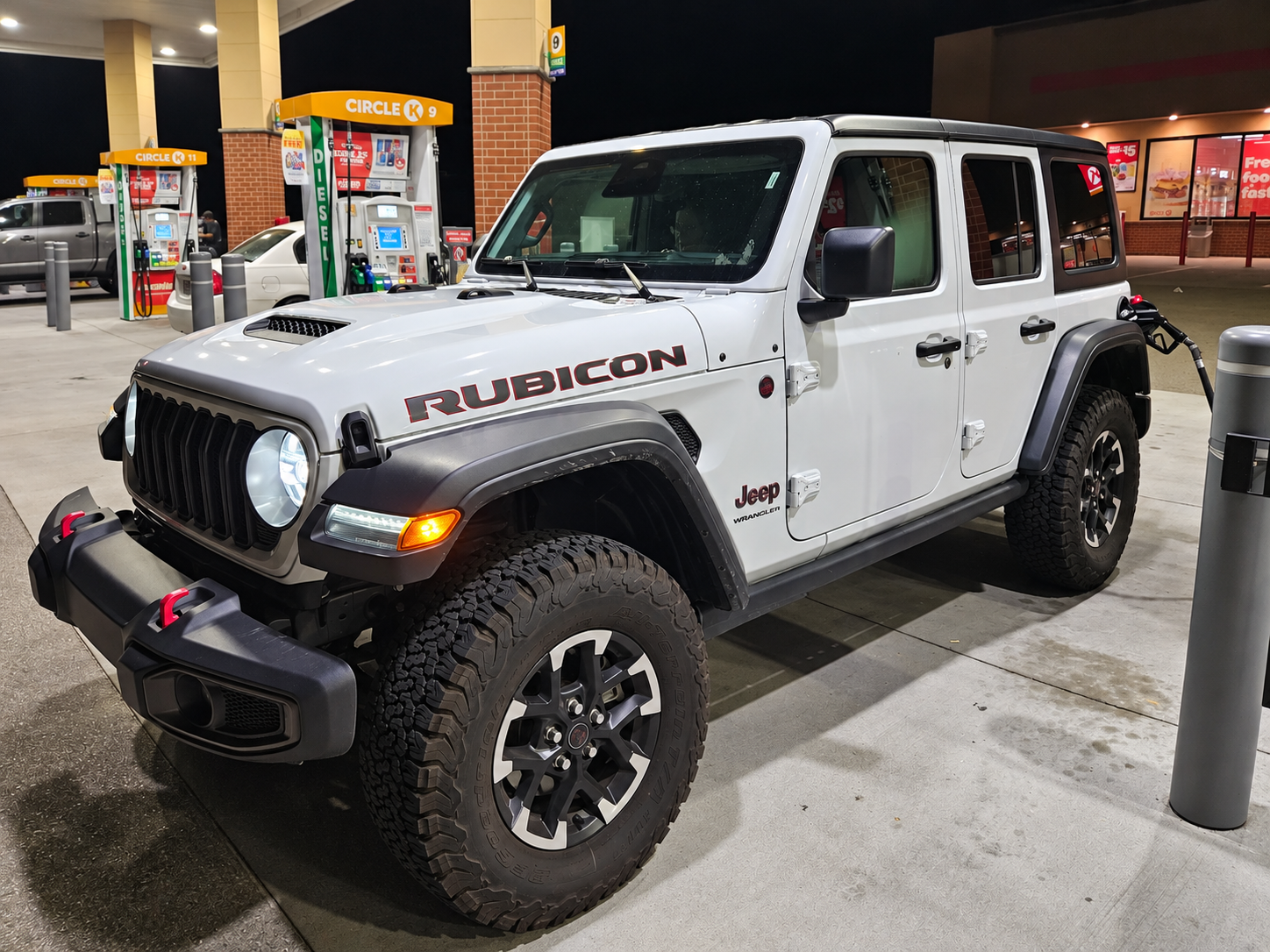
What surprised me was how familiar all of them felt.
There were differences in controls, suspension, gearing, and available technology, but I never felt like I was learning a completely different vehicle from scratch.
The JLU still felt like a Jeep.
That familiarity mattered on the trail.
I could concentrate on the terrain and what the Jeep was telling me instead of spending the day trying to figure out an unfamiliar platform.
There were still little differences to adjust to.
For example, manual shifting in my JKU is left and right, while the JLU uses forward and backward movement.
But those were nuances, not a completely different driving experience.
8. Rubicons Have Some Pretty Cool Trail Features
There were definitely features on this JLU Rubicon that my JKU Sport does not have.
The electronic sway-bar disconnect was nice.
Really nice.
Push a button.
Done.
My JKU has manual quick disconnects.
Would I rather push a button while sitting in the driver’s seat?
Of course.
But I still prefer the simplicity of the mechanical system overall.
Less can go wrong.
And if something does go wrong, I would generally rather diagnose and repair something mechanical than chase an electronic problem on the trail.
If you want a deeper explanation of what sway bars actually do off-road, I have an entire article about it:
Related article: Sway Bars and Off-Roading: What You Need to Know (Before You Hit the Trail)
Then there was the inclinometer.
That was just fun.
The JLU displays the Jeep’s pitch and roll angles on the screen.
Once everybody discovered it, the inclinometer almost became a game.
How much pitch?
How much roll?
How high could we get the number?
For the record:
Trying to set a personal high score with your inclinometer is not recommended.
But it absolutely added another layer of entertainment to the day.
9. A $417 Jeep Rental Can Actually Be a Pretty Good Value
The total for my rental was $417.39.
That is not pocket change.
But think about what I got for it.
Five people—me plus four passengers—experienced:
- Baby Lion’s Back
- the second half of Fins ’N Things
- Hell’s Revenge
- optional obstacles
- hours of slickrock driving
- an entirely different side of Moab from what most visitors experience from pavement
I also stopped at the top of Hell’s Gate and watched a couple of Toyotas tackle the climb.
I finished Hell’s Revenge by heading back out toward the entrance instead of taking the standalone exit.
There was still enough time to take the Jeep to a late lunch before returning it.
And all of that worked out to roughly $83 per person.
Put in those terms, I think the value becomes easier to understand.
There are plenty of things you can pay to do in a destination like Moab.
For about $400, five people got hours of entertainment, spectacular scenery, and an experience that several of them had never had before.
For me, the rental was absolutely worth it because it allowed my passengers to experience something they otherwise could not have experienced with me.
That mattered more than the Jeep.
Would I Rent a Jeep in Moab Again Even Though I Own One?
Possibly.
That surprised me.
I built my own Jeep to use it.
It has dents.
It has scrapes.
The skid plates are fully broken in.
The rock sliders have saved me more times than I can count.
And I am okay with all of that, because those marks are part of the Jeep’s story.
They are reminders of places I have been, trails I have run, obstacles I have crossed, and adventures I would not trade for a cleaner body panel.
That is part of why I own it.
I do not want a Jeep that looks like it has never been anywhere.
I want one that carries the memories of where I have taken it.
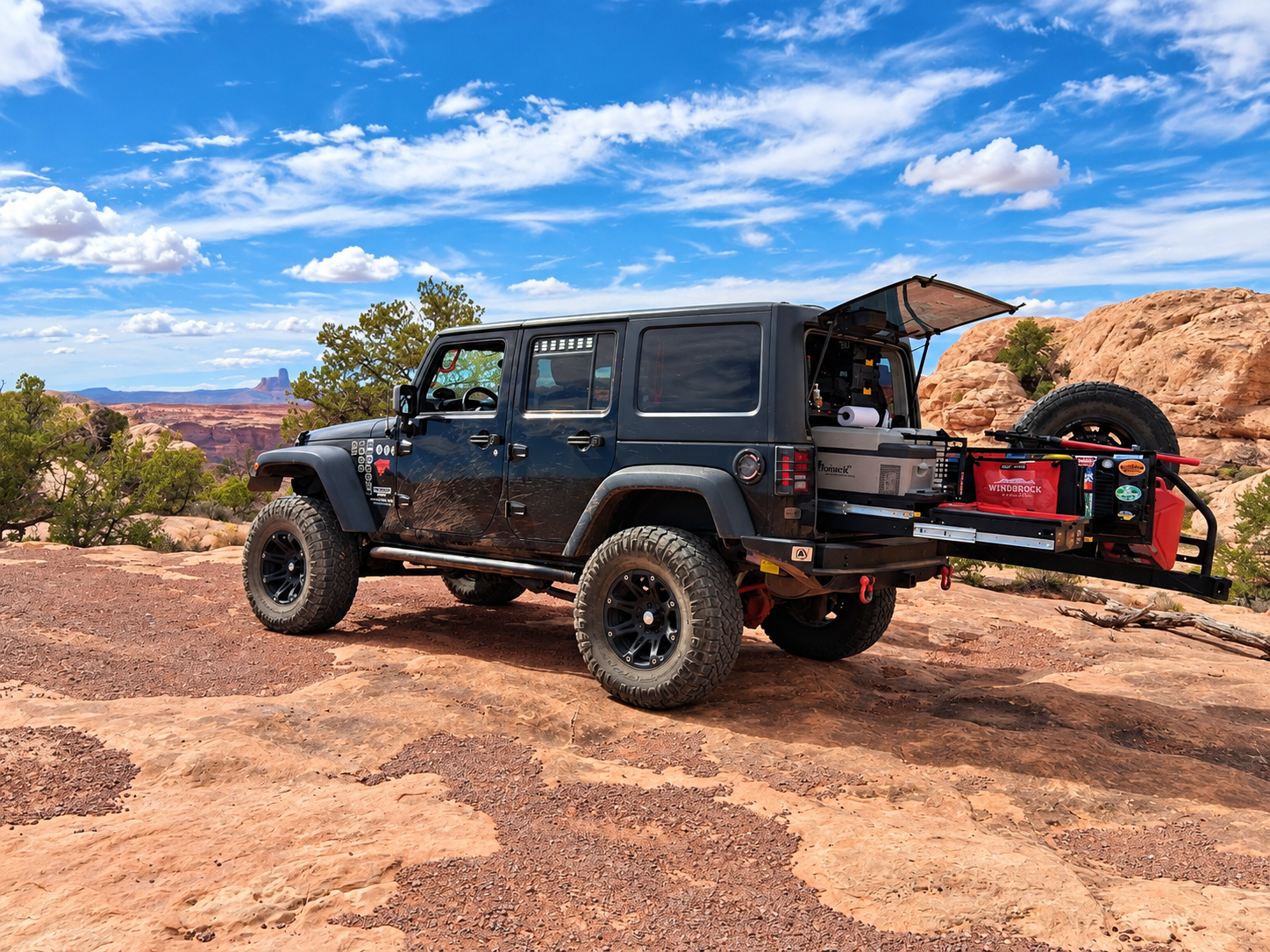
At the same time, I do not trailer it.
When I travel somewhere to wheel, I often drive a very long way to get there.
Frequently more than 1,000 miles.
My longest drive specifically to go wheeling was from Wilmington, North Carolina, to Moab, Utah.
And when the trail day was over, I still had to drive the Jeep home.
That creates a particular kind of pressure.
When you are tackling an obstacle, part of your brain is not just asking:
Can I get through this?
It is also asking:
Can I get through this and still drive more than 1,000 miles home?
A rental changes that calculation.
Obviously, damaging a rental can still have financial consequences.
But you are not jeopardizing the vehicle that has to carry you across the country afterward.
And that is where my thinking about renting gets a little complicated.
I do not want to protect my Jeep from adventure.
The dents, scratches, beaten-up skid plates, and scarred rock sliders are part of the memories.
They are proof that I actually used it for what I built it to do.
But there may still be times when renting makes sense.
Maybe I need passenger space.
Maybe I want to experience a different Jeep.
Maybe I am a thousand miles from home and want to enjoy a trail without worrying quite as much about whether my own Jeep will make the trip back.
Before this day, almost all of my real off-road experience had been in my modified JKU Sport.
My Jeep has a 4-inch lift, 35s, long arms, and a setup that I know extremely well.
I had driven JLUs, but I had never taken a JLU Rubicon out and wheeled it on Moab trails.
Now I have.
And it was fun.
Would I rent every time?
No.
Probably not.
Because part of the reason I own my Jeep is to make memories with that Jeep.
But am I much more open to renting in the right situation now?
Absolutely.
My Take on Jenn’s Jeep Rentals
My experience with Jenn’s Jeep Rentals was very good.
The reservation process was easy.
I completed the waiver and provided my insurance information online before arriving, so there was almost no paperwork at pickup.
The staff took time to discuss the trails I planned to run.
They clearly explained which obstacles were prohibited.
The Jeep was already aired down to about 17 PSI.
It was properly equipped for the terrain.
And returning it was simple.
Jenn’s describes itself as a small family-owned Moab company offering customized Jeeps outfitted specifically for Southern Utah terrain.
If I were doing it again, the biggest change I would consider would be picking up the Jeep the night before so I could maximize my trail time the following morning.
Jenn’s Jeep Rentals
Jenn’s Jeep Rentals
284 N Main
Moab, UT 84532
Phone: 435-220-1026
Rental prices, vehicles, trail restrictions, and policies can change, so verify the current information directly with Jenn’s before your trip.
Frequently Asked Questions About Renting a Jeep in Moab
Is renting a Jeep in Moab worth it?
For me, it was. Five people—me plus four passengers—spent the day experiencing several classic Moab trails for about $417 total. Because my own Jeep did not have rear passenger seating available, the rental made an experience possible that otherwise would not have happened.
How much does it cost to rent a Jeep in Moab?
My rental totaled $417.39 after taxes and fees. Jenn’s current pricing varies by vehicle, so check directly before booking.
Do you need a Rubicon to run Fins ’N Things?
No. A Rubicon gives you useful capability, but I have seen much less modified vehicles successfully run Fins ’N Things—including a stock Jeep Cherokee XJ. Driver experience, tires, line selection, and judgment matter tremendously.
Do you need 37-inch tires for Hell’s Revenge?
No. The rental’s 37s worked great, but they did not feel dramatically different to me from the 35s on my own JKU. My Jeep is also not stock. It has a 4-inch lift and a long-arm suspension, so that undoubtedly influences the comparison.
Is Hell’s Revenge a hard trail?
Jenn’s classifies Hell’s Revenge as a hard trail.
Personally, I would not describe the main trail that way, partly because easier lines and bypasses let you avoid some of its most difficult optional features.
When I think about truly hard Moab trails, Pritchett Canyon is a better example because many of its major obstacles do not offer bypasses. Cliffhanger is another step up because of its ledges, exposure, and sustained technical terrain.
However, Hell’s Revenge still has places where mistakes can carry serious consequences.
Beginner trails can still have expert consequences.
What tire pressure was the rental Jeep running?
Jenn’s told me the Jeep was at approximately 17 PSI. That worked well for the trails I ran and meant I did not need to carry deflators or an air compressor for the rental.
Should I pick up my Moab rental Jeep the night before?
If maximizing trail time matters to you, I would strongly consider it. I arrived shortly after opening and did not leave until about 8:40 AM because other renters were already being helped.
Do I need to rent a Jeep to drive Shafer Trail?
Not necessarily. Research the trail and honestly evaluate the vehicle you already have. If your vehicle is suitable for what you want to do, renting a Jeep may not add anything except the experience of driving a Jeep—which, to be fair, may be exactly what you want.
Can I take a rental Jeep through Hell’s Gate or the Hot Tubs?
Do not assume so. Those obstacles were off-limits with my rental, and rental-company rules can differ from what your own vehicle is capable of doing. Always ask the rental company about current trail and obstacle restrictions.
Fuel for the Drive to Moab
Moab mornings start early, and the best trail days begin with a hot cup before the sun clears the rim. That is why My 4×4 Experience Coffee is available right here on the site: honest, no-hype coffee for early trailheads and long drives home.
Experience It for Yourself
Reading about Moab is one thing.
Watching videos is another.
Neither one really prepares you for pointing a Jeep toward a slickrock fin and realizing just how steep it looks from the driver’s seat.
A photograph also does not fully capture what it feels like to be off-camber on a narrow section of trail with a very large drop sitting uncomfortably close to one side of the Jeep.
That is why I keep coming back to Moab.
And it is why My 4×4 Experience exists.
If you are considering a Jeep rental in Moab, research the trails first.
Find out whether you actually need the rental.
Understand what your rental company allows.
Be realistic about your vehicle and your experience level.
Then get out there.
Whether you bring your own 4×4 or rent one while you are in town, Moab is something you have to experience from behind the wheel to really understand.
Don’t just read about my 4×4 experience. Go create yours.
Experience it for yourself.