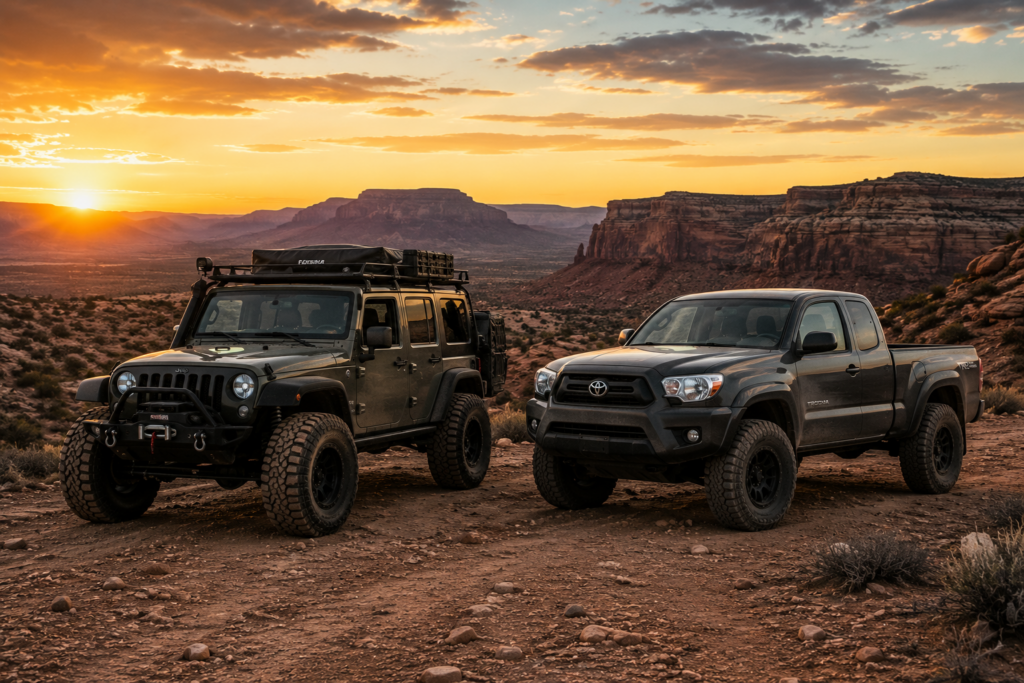
Owning both a Jeep Wrangler and a Toyota Tacoma has given me a unique perspective on two of the most respected off-road vehicles on the market. This isn’t a spec-sheet Jeep Wrangler vs. Toyota Tacoma comparison or a popularity contest—this is what I’ve personally learned from years of owning, driving, modifying, and relying on both rigs in real-world conditions.
Why I Bought Each Vehicle
I’ve always wanted a Jeep. Back in the late ’80s and early ’90s, I was sidetracked by the Geo Tracker and Isuzu Amigo. I never ended up getting either, but my Jeep dream faded for a while. That dream was reignited when I had the chance to buy my father-in-law’s 2005 Jeep Wrangler TJ X. My introduction to Jeeping was flying from Wilmington, NC, to Corpus Christi, TX, picking up the TJ, and spending the next few days driving it back home. That was an unforgettable experience, and I was immediately hooked. I did have one odd issue on that trip—the front driver’s side brake started locking up on day one but never gave me trouble again.
My wife and I both loved that TJ, but I wanted more room. About a year later, I bought a brand-new 2017 Jeep Wrangler Sport Unlimited (JKU). It was everything I wanted in a rig that could haul gear, handle the trail, and take me into the backcountry.
The Tacoma came into my life for a different reason. It was another family-owned vehicle I had driven a few times and really liked. When it became available, I bought it to replace my 2005 F-150 that I had owned for 13 years. That truck was a workhorse, and the 2014 Toyota Tacoma Access Cab TRD Off-Road took its place. It quickly became my daily driver.
Daily Driving Experience
I’ve used both the Jeep and Tacoma as daily drivers. I loved driving the Jeep, but at the same time, I hated putting mundane commuter miles on it. It’s purpose-built for overlanding—it’s a self-contained overland rig. It has heavy steel bumpers, a swing-out tire carrier that holds a spare tire and two 5-gallon fuel cans, a full interior rack system, a Morryde Trail Kitchen, and full underbody armor. With all those mods, my biggest fear was the Jeep being involved in a wreck during a simple commute.
The Tacoma, meanwhile, is extremely comfortable as a daily. It’s mostly stock, aside from a set of LT285/75R16 Nitto Trail Grappler M/Ts that replaced the original Toyo tires. I didn’t modify it, so everything’s simple and functional. It’s just a solid, reliable rig with a more refined on-road ride, thanks to its factory IFS setup and smaller tires compared to the Jeep’s 35-inch Nitto Ridge Grapplers.
Despite both vehicles having 3.73 axle ratios, the Tacoma tows with less strain. I attribute this to the Jeep’s added weight from all the overlanding gear; the Tacoma simply feels more efficient pulling the same load.
Modifications and Maintenance
The Tacoma has only needed routine maintenance—fluid and filter changes.
The Jeep? That’s a different story. Because it’s been heavily modified, I expect quirks and failures. I follow the “Buy Once, Cry Once” philosophy. I don’t cheap out on parts, and I prefer trusted brands. Here’s a more detailed breakdown:
- Driveshafts: I initially replaced the stock front driveshaft with a double cardan model as a preventative measure after noticing something odd. The second driveshaft eventually failed, likely due to lack of maintenance on my part. I now run an Adams Driveshaft, and I’m confident it will last the life of the Jeep.
- Control Arm Brackets: I’ve had to replace the rear passenger upper control bracket twice. The long arm suspension helps protect the underside, but the impact forces are transferred directly to those mounting points. Based on feedback from Adam at Elevate Jeeps in Katy, TX, the first repair likely wasn’t welded well. I’m now running Barnes 4×4 brackets welded to both sides.
- Steering and Suspension: I’ve replaced the stock ball joints with Teraflex Heavy Duty ball joints, swapped a failed Steinjager track bar for a Teraflex Monster Forged Track Bar, and upgraded the stock drag link with a Teraflex Heavy Duty Drag Link. These changes were essential after running oversized tires and pushing the suspension off-road.
- Trail Fixes: On Fins ‘n Things in Moab, I lost a brake line. I got back to town by putting the Jeep in 4LO and staying in 1st gear. Huge shoutout to Dixie 4 Wheel Drive (back when they had their Moab location) for helping me replace the extended brake line in a pinch.
The Jeep has quirks because it’s been messed with so much. When you swap parts, weld mounts, and upgrade components, you take on the responsibility of keeping everything dialed in. Bolts need to be checked. Clearances need to be verified. Stuff moves.
Quirks and the P06DE Code
One recurring issue I’ve had with the Jeep is a P06DE code. It first popped up while towing my Weeroll trailer across New Mexico. Between high RPMs, elevation, and wind, the code triggered under heavy load. The P06DE is linked to oil pressure staying higher than recommended for too long (typically more than 250 seconds). Though anecdotal, I’ve heard from many Jeep owners and mechanics that this code is rarely something to panic about unless it becomes frequent. It’s caused by a combination of factors, and the part involved is inexpensive but tough to reach.
Since then, I’ve adjusted how I drive. I now focus on keeping RPMs low when towing. Fuel economy improves, and the engine stays happier. At one point, before adopting this philosophy, my fuel economy dropped to 7 mpg on I-40 during high winds.
Off-Road Capability and Recovery
The Jeep has tackled Uwharrie, Moab, Sedona, Windrock, and a lot more. It excels at rock crawling and tight terrain. The Tacoma hasn’t seen as much, but it held its own in West Texas during a steep, rainy climb over fist-sized rocks. It handled River Road in Big Bend without issue, and flipping the switch to engage 4WD and the rear locker made it easy.
Still, I prefer the Jeep for remote solo trips. Its solid axles and mechanical simplicity give me confidence when alone in the backcountry. The transfer case lever feels more reassuring than the Tacoma’s electronic dial. Also, my Jeep is fully equipped for self-recovery, while the Tacoma didn’t even come with front recovery points. Solo trips are also why I wrote up 15 overland preparedness tips that could keep you alive out there.
Towing Performance
While both are rated to tow 3,500 lbs, the Tacoma feels more stable. Again, it likely comes down to the Jeep being heavier with all the gear bolted on. I feel safer towing with the Tacoma for long highway hauls, but I’ll still take the Jeep when the destination is extreme terrain.
Dealership Experience
The Tacoma has never been to a dealership under my ownership. The Jeep, however, has. And it wasn’t pretty. After welding on long-arm control mounts, I basically voided the warranty. When I took it in for a free oil change, it took the dealership an hour and three different lifts to figure out how to get it in the air. Their lifts and my long arms didn’t cooperate. And they even lost a cotter pin from one of my sway bar disconnects during service. I stick to specialty shops now.
Wheelbase, Driver Skill, and Real-World Performance
Wheelbase matters. Some trails favor short wheelbases (like 2-door Jeeps), others benefit from the longer platform of a JKU or Tacoma. And those Instagram reels comparing Jeeps and Tacomas? Most of them come down to driver skill and seat time.
As Hollie Fowler says, “Seat Time Over Everything.” Knowing your rig, its limits, and how it handles different terrain will take you farther than any mod ever will.
Fuel for Either Rig
Jeep or Tacoma, the day starts the same way: early, with coffee. My 4×4 Experience Coffee is available right here on the site: honest, no-hype coffee for early trailheads and long drives home.
Follow the Adventure
New trail reports, gear notes, and Moab updates go up on the My 4×4 Experience Facebook page first. Come along for the next one.
Conclusion: Jeep Wrangler vs. Toyota Tacoma
I love both of these vehicles. The Jeep is purpose-built for overlanding and rock crawling. It’s raw, capable, and rugged. The Tacoma is my go-to for long trips, daily driving, and moderate off-roading. It’s comfortable, reliable, and efficient.
Each rig has a role. For serious trails and solo backcountry trips, I choose the Jeep. For road trips with a few light trails along the way, it’s the Tacoma. The Jeep feels like home when things get rough. In the Jeep Wrangler vs. Toyota Tacoma debate, I don’t pick a winner. I pick the right tool for the trip.
Related reading: Sway Bars and Off-Roading: What You Need to Know (Before You Hit the Trail) and Jeep Hard Top vs. Soft Top: Real-World Pros and Cons from an Overland Enthusiast.
I’m waiting to get some money saved up to put a new radiator/fan setup in the old YJ. Work let me get a 2025 Tacoma TRD offroad last November. I love that truck for what I need it for in the field. It will never get used to its full potential at work though.